Coffee at home
7 Best Home Espresso Machines for Your Morning Coffee
The short answer
I recommend the Breville Bambino Plus for most beginners. Choose a dual boiler for several milk drinks, or the Magnifica Evo for a one-touch routine.
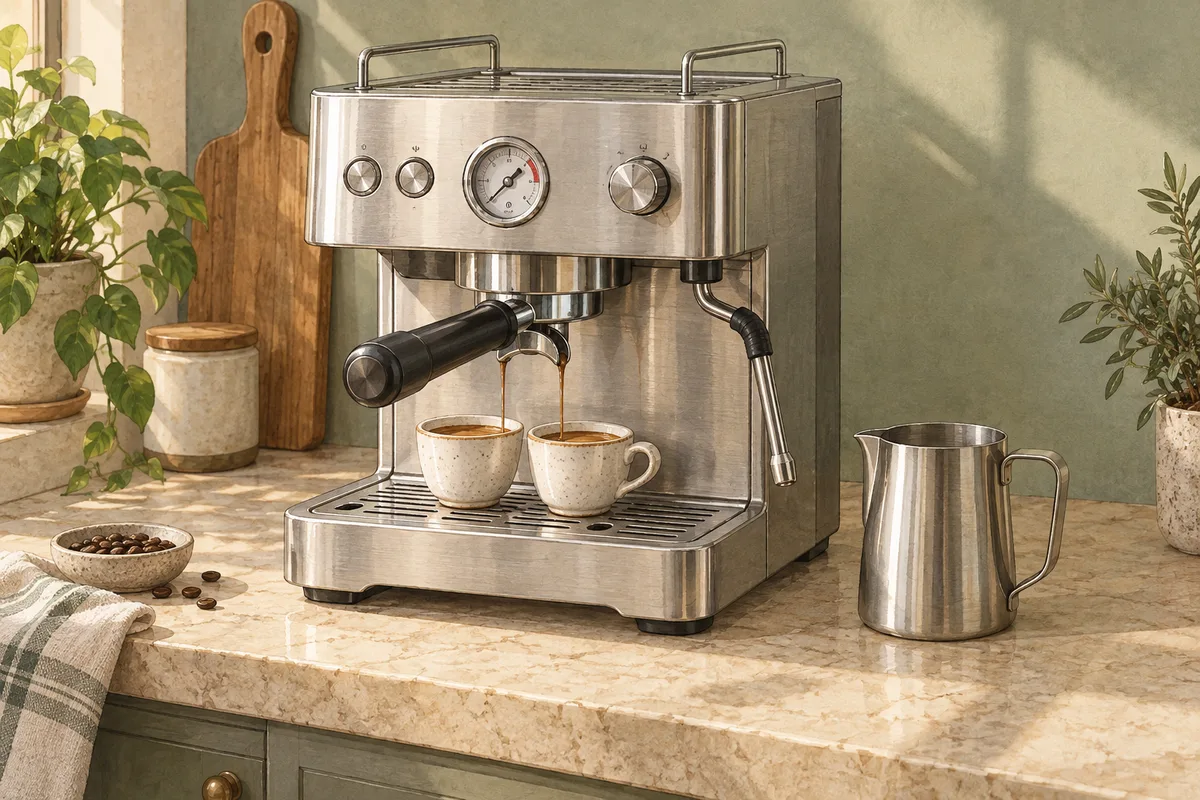
I would choose a home espresso machine by the drink I want on a busy morning. A small machine with easy milk steaming can be a better buy than a large one with controls I rarely touch. If I want to tune each shot, those extra controls start to earn their space.
The other half of the choice is the grinder. Most machines here need a separate espresso grinder. Put that in the budget from the start. Fresh beans, a sound grind, and a repeatable routine do more for a cup than a long list of buttons.
The best home espresso machines at a glance
| Espresso machine | Who I would choose it for |
|---|---|
| Breville Bambino Plus | Most beginners who want quick coffee and easy milk |
| Breville Barista Express Impress | A tidy setup with grinding and assisted tamping |
| Gaggia Classic Pro E24 | A hands-on learner who likes simple controls |
| Profitec GO, 0.4-liter version | Espresso drinkers who want settable heat in a small machine |
| Breville Dual Boiler BES920 | Milk drinks with control over the brew |
| Rancilio Silvia Pro X | Several drinks in a row, with separate brew and steam boilers |
| De'Longhi Magnifica Evo ECAM29084SB | One-touch drinks with an automatic milk carafe |
I would buy the Bambino Plus for a first setup unless I knew I wanted more control. I would move to a dual boiler espresso machine for several milk drinks in a row. A bean-to-cup machine is the better route if I want the drink with less hands-on work.
1. Breville Bambino Plus: my pick for most beginners
The Breville Bambino Plus is the espresso machine I would put in most first kitchens. It keeps the daily steps short. Its ThermoJet heater reaches its start heat in about three seconds. The steam wand can texture milk for you.
That quick start does not mean every cold cup and metal part is warm. I would run the warm-up steps in the manual and warm the cup. A fast heater saves time, but it does not remove the need for a good routine.
Why I would choose it
The Bambino Plus has a 54mm portafilter, the handled basket that locks into the machine. You get single-wall and dual-wall filter baskets. You can learn with different grinds. Then move to fresh beans and a single-wall basket.
I like the choice of automatic or manual milk steaming. Let the machine help at first, then take over the milk jug when you want to learn. You do not need to replace the whole espresso machine just to practice latte art.
In this one-year Bambino Plus account, an owner shares a year of latte-art practice. The owner uses manual steam. It is a useful example of room to grow. It is not proof of a fixed lifespan or the results every buyer will get.
What I would weigh up
There is no built-in grinder. A good separate espresso grinder adds cost and counter space. I see that as a fair trade because you can keep the grinder if you later change the machine.
The Bambino Plus gives you less control over brew heat. I would choose it for a simple daily cup, especially with milk. I would look elsewhere if changing the brew temperature was part of the hobby I wanted.
Best fit: A quick first espresso machine with useful help for milk.
Main limit: You need a grinder, and you get fewer brew controls.
2. Breville Barista Express Impress: best for a tidy all-in-one setup
I would choose the Breville Barista Express Impress for a cook who wants one main station for coffee. The built-in grinder feeds the basket, and the side lever helps press the grounds. It cuts down the loose tools and spilled coffee around the machine.
This is the BES876 model. It is different from the Barista Express and the Touch Impress. Similar names do not mean the same heater, controls, or milk system.
Why I would choose it
The grinder has 25 external grind settings. The machine helps with the amount of coffee. Assisted tamping helps you press it the same way each time. You still choose the grind and judge the cup.
I like it for someone who wants to learn espresso without building a bench of separate tools. Grind, tamp with the lever, move the portafilter, and brew. The manual steam wand leaves milk texture in your hands.
Its Thermocoil heater uses PID temperature control. PID is a control system that helps keep heat near the chosen setting. The Barista Express Impress is not a dual boiler espresso machine. It cannot brew and steam at once.
What I would weigh up
Assisted tamping does not make every bean taste good at the same setting. You still need fresh coffee, a sensible dose, and a grind that suits the shot. The grinder and espresso machine share one body. That limits the parts you can change later.
I would buy it if I wanted a neat routine more than separate grinder choice. For more freedom to change beans and tools, I would choose the Bambino Plus. A separate grinder gives me more room to grow.
Best fit: Grinding and assisted tamping in one main machine.
Main limit: You still tune the shot and steam milk by hand.
3. Gaggia Classic Pro E24: best for learning a hands-on routine
The Gaggia Classic Pro E24 suits someone who wants to learn the steps rather than hand them to the machine. It has rocker switches, a 58mm portafilter, and a manual steam wand with a two-hole tip.
The E24 has a brass boiler. That is an important model detail when you read older Gaggia Classic Pro reviews. I would check the exact E24 listing and US version before buying from a seller with mixed stock.
Why I would choose it
I like the clear division of jobs. The espresso machine supplies hot water and steam. You grind the beans, weigh the dose, tamp, and choose when to stop the shot. There is little doubt about which step you control.
The 58mm basket size gives access to a broad range of tools. It does not make the espresso better by itself. I would learn with the supplied basket first. New baskets can wait.
This Gaggia Classic uses one boiler for brewing and steam. You change modes, wait for heat, then return to brew conditions for the next shot. That is workable for one drink at a time if you accept the pause.
What I would weigh up
The standard Classic Pro E24 does not have a user-set PID display. A brass boiler does not change that. Want to set the brew heat? The Profitec GO gives you that control from the start.
I would not buy a Gaggia Classic on the assumption that I must modify it. Choose the stock machine for the way it works today. Changes inside the machine add cost. They can also affect safety and warranty cover.
Best fit: A learner who enjoys weighing, timing, and manual milk work.
Main limit: One boiler and no built-in user-set PID display.
4. Profitec GO: best compact choice for heat control
I would choose the Profitec GO listed by Whole Latte Love for straight espresso with more control over heat. This comparison covers the 0.4-liter brass-boiler version in that US listing.
Profitec also lists a refreshed GO with different controls and a 0.3-liter boiler. Check the version before ordering. I would not assume that an older unit has the newer screen or pre-infusion features.
Why I would choose it
The 0.4-liter GO has PID temperature control, a shot timer, and a pump-pressure gauge. Those features help you repeat a recipe and see what changed. It still needs a separate espresso grinder.
I like it as a focused step up from a basic single boiler espresso machine. You can set the brew heat without buying the space and cost of a second boiler. That suits a fan of straight espresso. A home that makes lots of large lattes has other needs.
The US dealer lists a 2.8-liter water reservoir and a warm-up routine of about five to seven minutes. I would follow the ready and flush prompts. The timer on a wall clock cannot tell you every part is ready in every room.
What I would weigh up
Single boiler machines still need to change temperature between coffee and milk. A PID does not remove that step. For two milk drinks at once, I would compare a dual boiler espresso machine. It may suit that job better than the GO.
I would also check who handles service in my area. A solid machine is only part of ownership. Parts access, shipping, and a clear repair route can matter long after the first cup.
Best fit: Mostly espresso, with settable heat in a small setup.
Main limit: Milk drinks need the single-boiler changeover; versions differ.
5. Breville Dual Boiler: best for brew controls and milk together
The Breville Dual Boiler BES920 is my pick to compare for fast milk and brew control. It has a dedicated brew boiler, a separate steam boiler, and a heated group head.
That setup lets you pull a shot and steam milk at the same time. It removes the main pause found on single boiler machines. You still need to grind, dose, tamp, and handle the milk pitcher.
Why I would choose it
The Breville Dual Boiler has PID control, a 58mm portafilter, and low-pressure pre-infusion. You can use shot controls or choose when to end the brew. The screen and pressure gauge make the steps easier to follow.
I would choose this dual boiler espresso machine for a few morning milk drinks. One person can learn slowly; the other does not have to wait for a boiler to switch from steam back to coffee.
I also like the balance of familiar controls and room to learn. More settings help only when you change them with a purpose. I would keep most fixed while learning a new bean.
What I would weigh up
There is no built-in grinder. This is a wider, more involved setup than a Bambino Plus. Add room for a grinder, a scale, and the milk jug before judging whether it fits.
The official US BES920 listing can be out of stock. Ask an authorized US seller about stock and repairs. Read the warranty terms too. I would not pay a large markup to get this model. A Silvia Pro X could meet the same main need.
Best fit: Milk drinks with hands-on control over brewing.
Main limit: A larger setup, plus a separate grinder and stock to check.
6. Rancilio Silvia Pro X: best for several drinks in a row
I would put the Rancilio Silvia Pro X on the shortlist for a home that makes several milk drinks in one session. It pairs a 0.3-liter brew boiler with a 1-liter steam boiler. Each has its own PID heat control.
This is the Pro X, not the standard Silvia. The two machines have different heating systems. A review of the single-boiler Silvia does not describe the Pro X routine.
Why I would choose it
The Silvia Pro X can brew and steam at once. It has a 58mm portafilter, a 2-liter tank, a pressure gauge, and a separate hot-water outlet. Soft infusion wets the coffee puck first. Full brew pressure comes next.
I like those features for a cook who wants a clear, repeatable routine. Brew the coffee, steam the milk, wipe the wand, and prepare the next basket. A single boiler espresso machine needs more time to switch jobs.
A dual boiler does not force you to rush. You can learn one step at a time, then overlap them when you feel ready. The value is having that choice when several cups need to reach the table.
What I would weigh up
This is a substantial machine, and a separate espresso grinder is still essential. I would check depth, space above the tank, and access to the drip tray. A machine that fits a bare counter may be awkward under a low cabinet.
I would choose it for the daily routine, not the idea of owning a small commercial espresso machine. Home use has different demands from a coffee shop. A few well-made drinks do not require café-sized equipment.
Best fit: A household that wants dual-boiler coffee and manual milk control.
Main limit: Cost, counter space, and a separate grinder.
7. De'Longhi Magnifica Evo: best for one-touch milk drinks
I would choose the De'Longhi Magnifica Evo ECAM29084SB for coffee with fewer manual steps. This version has the LatteCrema milk carafe and a built-in grinder with 13 settings.
Other Magnifica Evo versions use a manual milk frother. Check the full model code. A lower-priced listing with a steam wand is not the same one-touch milk setup.
Why I would choose it
This espresso machine grinds and brews inside the body. You do not move a portafilter between a grinder and a group head. Its seven drink choices span hot and cold drinks. You get espresso, cappuccino, and latte macchiato. Coffee, hot water, iced coffee, and My Latte round out the list.
I like that approach for a shared kitchen. Each person can choose a drink with fewer manual steps. There is no need to learn how to hold a milk pitcher at a steam wand before the first latte.
Super-automatic machines suit a different goal from a semi-automatic espresso machine. They trade some control for a shorter routine. I would judge the Magnifica Evo by whether I enjoy its drinks and can keep it clean.
What I would weigh up
The milk carafe still needs care. So do the grounds bin, drip tray, and parts named in the manual. Automatic milk frothing does not make old milk safe to leave in a warm machine.
I would choose a manual steam wand if I wanted to pour latte art or change milk texture by hand. I would choose the Magnifica Evo if I wanted a familiar drink with fewer steps on a workday.
Best fit: A simple bean-to-cup routine with automatic milk.
Main limit: Less hands-on brew control, with regular milk-system cleaning.
Which kind of espresso machine fits your morning?
I would decide how much work I want before comparing brands. An espresso maker can be a daily tool, a hobby, or both. Buying for a hobby you do not want is a costly way to make breakfast harder.
Semi-automatic machines: you prepare the coffee
A semi-automatic espresso machine uses a pump to push water through coffee. You usually grind, dose, and tamp the grounds yourself. Some machines stop the shot at a set amount; others leave that to you.
The portafilter is the handled part you lock into the front. Its basket holds the coffee. The group head is where hot water enters that basket. Once those parts make sense, the routine is much less daunting.
I would choose a semi-automatic machine if I wanted to learn why one shot tasted better than another. You can change one step, taste the result, and keep what works. The cost is time, mess, and a few cups you may not love at first.
Most of the machines here fit that route. The Barista Express Impress helps grind and tamp. You still move the basket and steam the milk. It does not do the same job as a fully automatic coffee machine.
Super-automatic machines: the brew happens inside
Super-automatic machines grind the beans and form the coffee puck. They brew, then drop the spent grounds into a bin. An automatic milk system adds another shortcut. You still refill beans and water and clean the parts.
I would choose this type for a home where several people want a familiar drink with little training. It is also useful when someone finds a portafilter hard to grip or tamp. Try the controls and cleaning steps as well as the coffee.
The main limit is control. You can change settings, but you cannot prepare the puck in the same way as a separate basket. That is a fair trade if the result suits you. There is no prize for doing more work than you enjoy.
Manual espresso makers: more work at the cup
A manual espresso machine may use a lever or hand pressure instead of a powered pump. Some need a separate kettle, and many have no milk system. That can suit a careful, small-scale routine.
I would choose one for someone who enjoys the process and mostly drinks espresso. I would not make it the default for a shared home that wants several lattes before work. Count every step, including warming parts and heating milk elsewhere.
Manual does not automatically mean better espresso. A well-prepared shot on a simple pump machine can be lovely. The useful question is how much control you want to hold in your own hands.
Single boiler or dual boiler espresso machine?
This choice changes the pace of milk drinks. Brewing coffee and making steam need different heat levels. An espresso machine has to manage that gap in some way.
A single boiler does two jobs in turn
Single boiler machines use the same boiler for brew water and steam. Make the espresso, raise the boiler temperature, then steam milk. Before the next shot, bring the machine back to its brew state as the manual directs.
I would accept that pause for one cappuccino at a time. I would find it less useful when three people all wanted large milk drinks. The right choice depends on the busiest normal morning, not a rare dinner party.
A single boiler espresso machine can still offer excellent control. The Profitec GO adds PID control without a second boiler. You get a settable brew temperature, but you still wait when switching jobs.
A dual boiler keeps coffee and steam separate
A dual boiler espresso machine has one boiler for brewing and another for steam. The two can stay at different temperatures. That is why models such as the Breville Dual Boiler and Silvia Pro X can brew and steam at once.
I would pay for that when milk drinks are a daily habit for more than one person. It helps keep the pace steady. A dual boiler also lets you work on the milk while the shot runs, once you are comfortable doing both.
The second boiler adds cost, size, and another part to maintain. It does not grind the beans or fix a poor puck. If I mostly drank one straight espresso, I would put more weight on the grinder than the second boiler.
Fast heaters follow a different route
Thermoblock, Thermocoil, and ThermoJet systems heat water through a compact heating path. They are not all the same design. The Bambino Plus and Barista Express Impress use different Breville systems.
A fast start can matter more than dual-boiler speed for one morning drink. I would compare the whole routine. Count warming the cup, grinding, brewing, steaming, and cleaning. A claim about heater readiness covers just one part of that time.
Do not treat every fast-heating espresso machine as though it can brew and steam together. Check the specific model. Quick switching and simultaneous use are different features.
Put the espresso grinder in the budget
For a machine with a single-wall basket, the grind has a large effect on flow. Coffee that is too coarse can let water race through. Coffee that is too fine can slow the shot to a crawl.
An espresso grinder needs to grind finely and let you make small, useful changes. A grinder that works well for drip coffee may not give enough control for espresso. A blade grinder also makes it hard to repeat the same particle size.
A built-in grinder keeps the setup together
I like a built-in grinder when it makes the routine easier to keep. The Barista Express Impress puts grinding and assisted tamping beside the brew group. There are fewer separate pieces to place on the counter.
The tradeoff comes when your needs change. You may want a different burr style, smaller grind steps, or a simpler way to switch beans. A grinder built into the machine can still work well, but it does not give the same freedom as a separate unit.
I would judge the grinder by the coffee it can help me make. Lots of grind settings can help. The gap between each setting matters too. More numbers alone do not promise more consistent shots.
A separate grinder gives room to change
A standalone grinder can stay when the espresso machine changes. It can also sit where the work makes sense, rather than where the machine maker put it. That can be useful on a narrow or divided counter.
The price is another cord, another tool to clean, and more space. Some grinders also hold a small amount of old grounds inside. I would learn the maker's steps for switching beans and clearing retained coffee.
A hand grinder can lower the equipment bill, but espresso takes effort. Think about the number of double shots you make each day. Grinding by hand once on Sunday is not the same job as doing it four times before work.
Fresh beans make the settings worth using
Choose beans you enjoy and keep the first bag simple. Start with a familiar medium roast. It can be hard to learn while switching beans each day. That is a starting choice, not a rule about what tastes best.
Check the roast date and follow the roaster's advice on rest and storage. Keep beans sealed away from heat and light. Do not fill a large hopper for the sake of how it looks if you drink slowly.
The same grind setting may need a small change as beans age. That is normal. I would use the scale and taste of the shot to guide the next step, not keep turning the dial at random.
Features I would pay for, and features I would question
The best espresso machine for one home can have too many controls for another. I would give each feature a job before paying for it. If I cannot name the job, I can probably wait.
PID temperature control
PID control helps the espresso machine keep heat near a set point. Some models let you choose that point. Others use a fixed setting. Those are different levels of control even when both list PID in the features.
I would want to set the brew heat if I liked trying new coffees. I would give it less weight if I wanted one milk drink from the same beans each day. Stable habits can be more useful than constant setting changes.
The display does not measure the temperature of the drink in your cup. It may show a boiler setting or a value adjusted by the maker. Read the manual before comparing screen numbers across two machines.
Pressure gauges and pump numbers
A pressure gauge can help you see what happens during a shot. It cannot tell you whether the espresso tastes good. A reading depends on the machine, the coffee, and where pressure is measured.
Do not buy an espresso maker because its pump advertises the biggest bar number. Breville lists a 15-bar pump, for example. Its brew system uses less pressure at the coffee. Pump capacity and pressure at the coffee are not the same claim.
I would use the gauge as one clue alongside time, yield, and taste. If the manual gives a normal range, start there. Do not chase a needle position while ignoring a cup you like.
Pre-infusion and soft infusion
Pre-infusion wets the coffee before full brewing pressure. The exact method varies. On some machines, you can change its length; on others, it is built into the cycle.
I would see it as a useful control, not a rescue for badly prepared grounds. A level bed and even tamp still matter. Keep pre-infusion fixed while you learn. Change it later with a clear reason.
Be careful with model names. The refreshed Profitec GO lists features that the older 0.4-liter version does not share. A product family name is not enough to confirm what a particular unit can do.
Basket size and included tools
A 58mm portafilter is common on many home and commercial machines. The Bambino Plus and Barista Express Impress use 54mm baskets. Both sizes can make espresso; neither is a quality score.
Buy tools that fit the exact basket and machine. Nominal diameter does not settle every fit question. Portafilter tabs, basket depth, and the shape of a tamper can all matter.
I would start with the supplied tools and one suitable scale. Learn what is awkward before replacing things. A tool that fixes a real daily problem is more useful than one bought to match a photo.
Check the space before you buy
Measure the counter, then leave room to use the espresso machine. A depth figure does not include all the space needed to remove a portafilter or pull out a drip tray. The machine also needs a stable, dry surface.
Check how the water tank fills. A top-fill reservoir under a low cabinet can be hard to reach. A removable tank may need space behind the machine. Think about a full tank, not just an empty one.
Leave room for the steam wand to swing and the milk pitcher to sit at an angle. Check the height between the spouts and drip tray with your cup and scale together. A favorite tall mug can change the fit.
Use the power supply and outlet the maker specifies. A US machine should match the local voltage and its rated supply. I would not import a unit with the wrong voltage to save money.
If the kitchen also holds large pans and food-prep tools, keep the working area honest. Our induction cookware guide can help you avoid a set of pots that crowds the same small kitchen.
Noise matters too. Grinders, pumps, and steam all make sound. If someone sleeps close to the kitchen, I would listen to the model in use where possible. A short burst that seems mild in a shop may feel different in a quiet home.
A simple routine for the first good shot
I would keep the first week boring on purpose: one bag of beans, one basket, one dose, and one cup. That makes it easier to see what a change did. You can explore more once the basic routine feels calm.
Warm the machine and cup
Follow the model's start-up steps. Give boiler machines the time and flush routine they need. Breville's espresso guide includes a hot-water flush. It warms the group and portafilter.
Do not assume the hot water left in a cup belongs in the drink. Empty and dry the cup before weighing the shot. Dry the basket as well so fresh coffee grounds do not cling to wet patches.
A warm cup helps keep a small espresso from cooling too fast. It will not cure an underheated brew path or a poor grind. Work through one cause at a time if the first shot tastes thin or cool.
Pick a dose that fits the basket
Dose means the mass of dry coffee in the basket. Start with the basket maker's range. An 18-gram basket and a smaller single basket should not receive the same amount of coffee.
Use a scale instead of judging a mound by eye. Level the grounds and tamp straight. The goal is a repeatable bed, not the hardest possible push. Keep the rim clean so the portafilter can seal properly.
Leave the space the manual calls for above the coffee. Overfilling can press the puck against the shower screen. Underfilling a large basket can create a different set of problems. More grounds do not always mean a better shot.
Weigh what lands in the cup
Yield means the mass of brewed espresso. As a simple example, I might start with 18 grams of coffee and aim for 36 grams in the cup. That is a 1:2 ratio: twice as much drink as dry coffee by weight.
Treat that as a starting recipe, not a law. Some beans taste better with a shorter or longer yield. Your basket and machine manual may suggest a different starting point. Keep notes so a good cup is easy to repeat.
Start the scale at zero with the empty cup on it. Watch how much coffee arrives before you stop the shot. A two-cup button is a useful shortcut, but the amount can change when the grind changes.
Use time as a clue
The shot time helps show whether the flow changed. Count it the same way each time, such as from pressing the brew button. Pre-infusion can make comparisons between machines less direct.
If water rushes through, the grind may be too coarse or the puck may have weak spots. If almost nothing comes out, the grind may be too fine or the basket too full. Look at the whole setup before blaming the espresso machine.
I would change one variable at a time. Keep dose and target yield fixed while making a small grind change. Then taste the new shot. Changing dose, grind, temperature, and yield at once makes the result hard to learn from.
Taste before chasing a number
Sour, bitter, thin, and dry are useful words, but beans have their own tastes too. A bright coffee is not always under-extracted. A dark roast is not always burnt by the machine.
I would ask whether I want more sweetness, less sharpness, or a fuller body. Then make a small, clear change. If a recipe tastes good, it does not need to match someone else's exact seconds or gauge reading.
For milk drinks, taste a little espresso before adding milk. That helps show whether the coffee or milk step needs work. Keep the final drink size steady while you learn, so each cup is a fair comparison.
Steam milk without making it the whole morning
Milk is where the machine choice often becomes clear. An automatic steam wand can save attention. A manual wand gives you more direct control. A milk carafe removes still more of the hands-on steps.
Learn one jug and one amount
Start with cold milk and a clean milk pitcher that suits the wand. Follow the machine's fill range. Too little milk can be hard to reach; too much leaves no room for expansion.
With a manual steam wand, the tip position changes how much air enters. A shallow start adds air, and a deeper position can help the milk roll. Aim for a smooth texture rather than a large pile of dry bubbles.
I would practice the same small amount until it feels repeatable. Large milk jugs are not automatically easier. A jug sized to one drink can reduce waste and make the routine more consistent.
Automatic milk still needs a clean wand
The Bambino Plus can texture milk for you. You still need to wipe and purge the wand. Milk left on a hot tip dries quickly. Do that small job while it is easy.
A Magnifica Evo milk carafe follows its own cleaning routine. Remove, rinse, and wash the parts named in the manual. Do not put every component into a dishwasher just because some parts are dishwasher safe.
Milk systems are a good place to be honest about habits. I would not choose automatic espresso machines to avoid cleaning. I would choose one because I preferred its brew routine and could keep up with its care.
Milk choice changes the result
Whole milk, lower-fat milk, and oat milk do not all foam the same way. Different plant-based products can behave quite differently too. Start with the product you want to drink and adjust the technique around it.
If latte art matters, a smooth, flowing texture is more useful than the largest foam cap. If you prefer a thick cappuccino top, your goal may differ. The best milk frother is the one that helps make your kind of drink.
I would learn a steady pour before buying more equipment. A simple white cup, a familiar milk jug, and repeated practice can teach a lot. New tools will not remove the need to learn how the milk moves.
Water matters to taste and the machine
Water is part of the recipe and part of the care plan. Hard water can leave scale as it is heated. A filter that improves taste may not remove hardness minerals. Those are different jobs.
La Marzocco's water guide explains both extremes. Too many minerals can cause problems. So can water that is too pure. I would use the water limits from the maker of the machine I buy. One brand's target is not a universal recipe.
Test the water or get a current report before deciding what treatment you need. Follow the supplied hardness-test steps when a machine includes them. Set its reminder system as the manual directs.
Scale may affect the whole home. Our water softener system guide explains what can help. A household softener does not automatically make water ideal for an espresso machine. Check the treated water against the machine's own limits.
Bottled or filtered water may still be a poor fit. The same is true of reverse-osmosis and distilled water. Mineral content varies, and some very pure water needs treatment before use. I would ask the maker for a clear water plan if the local supply falls outside its range.
What ownership costs after the box arrives
The espresso machine is only the first line in the budget. Add a grinder if needed, beans, cleaning supplies, water treatment, and any tools the box lacks. Set aside room for service too.
I would price a complete setup before comparing machines. A cheaper machine with no grinder may cost more as a working system than an all-in-one. It may still be the better choice if the separate grinder suits your needs.
Compare real daily use
A machine saves café spending only when you use it instead of buying those drinks. Beans and milk still cost money, and some coffee gets used while learning. A large machine left idle is not a saving.
I would estimate the drinks I make in a normal week. Then compare the complete equipment cost with the amount I actually replace. Keep the result rough; it is a buying aid, not a promise about a payback date.
Think about time as well. A home espresso routine includes filling, weighing, brewing, wiping, and washing. That can be a pleasant ritual. It can also be one more task on a rushed morning.
Check the repair route
Before buying, find out who handles warranty work and later repairs. Check whether the machine ships to a service center or can be repaired nearby. Ask about packing and transport, especially for a heavy dual boiler.
Warranty length alone does not tell the full story. Read what is covered and what care the maker requires. A seller's added warranty can have different terms from the manufacturer's cover.
I would favor a clear service route over a small price cut from an unknown seller. That does not mean the machine will fail. It means I want a sensible plan if a seal, pump, switch, or heater needs attention.
Buy accessories after you find a need
A fitted tamper, a useful scale, and a milk jug cover a lot. Some espresso machines include those tools. Check the box list before ordering duplicates.
I would wait on extra baskets, stands, and gadgets until I knew what slowed me down. A better-fitting scale can solve a real problem. A shelf of tools can also crowd the counter without improving the coffee.
Keep coffee supplies separate from food storage needs. For packed lunches and leftovers, these meal prep containers cover a different job. A tidy kitchen gives both routines room to work.
Cleaning that keeps the next cup simple
I would make the small daily jobs part of the drink. A rinse now is easier than dried milk later. The exact cleaning schedule depends on the machine, water, and number of drinks.
After each coffee session
Remove spent grounds, clean the basket as directed, and wipe the steam wand after milk. Follow the purge routine. Empty and rinse the drip tray before it overflows.
Use a cloth for the steam wand that is clean and suitable for the job. Keep cleaning water away from controls. Let hot parts cool enough to handle safely.
A super-automatic machine tells you when to empty its grounds bin. Clean its removable parts as directed. The machine can count drinks; it cannot judge every spot of old milk for you.
Backflushing and descaling are different
Backflushing cleans the brew path on machines designed for it. Descaling deals with mineral deposits. One is not a substitute for the other, and not every machine uses the same method.
Use the products and steps the maker permits. Check the right place for a blind basket, cleaning tablet, or acid cleaner. Follow the model guide. Two machines can look alike and need different care. Use the guide for your model.
Some more involved machines need professional help for certain scale problems. Check before a small issue becomes a large one. The right water from day one makes the care plan easier to follow.
Common problems before blaming the machine
| What happens | What I would check first |
|---|---|
| Shot runs very fast | Grind size, dose, and whether grounds are level |
| Only a few drops appear | Grind too fine, basket too full, or a cleaning need |
| First cup feels cool | Warm-up routine, cup temperature, and flush steps |
| Milk has large bubbles | Tip position, milk amount, and steam technique |
| Steam weakens | Water level, selected mode, and permitted tip cleaning |
| Two shots taste different | Dose, yield, retained grounds, and warm-up consistency |
| Water pools on the counter | Drip tray, tank fit, and a possible leak needing service |
Stop using the machine if its cord is damaged or it has an electrical fault. Do the same for a leak near powered parts. Routine recipe tuning is one thing; a fault needs the maker or a qualified service person.
Questions I would settle before ordering
Is Breville or De'Longhi better for home espresso?
I would compare the type of machine before the brand. The Breville Bambino Plus gives you a portafilter routine with help for milk. The Magnifica Evo version here grinds and brews inside the machine and uses a milk carafe.
Choose Breville's manual-style route if you want to prepare the puck and learn the shot. Choose the Magnifica Evo if you prefer one-touch drinks. Both still need care, and the exact model matters more than the badge.
Do I need a dual boiler espresso machine for two people?
Not always. If you drink espresso without milk, a second boiler may add little to your morning. If both people want large lattes, a dual boiler can make the routine much smoother.
I would think about how often I change between coffee and steam. Buy the second boiler to solve that wait. Do not buy it just because it sounds like the next required step.
Can I use pre-ground coffee?
Some machines accept it through a dual-wall basket or a designated bypass chute. Check the manual. Pre-ground coffee removes a task, but you cannot tune its grind to the shot in the same way.
I would use the correct basket or chute and stay within the dose limit. Never pour ground coffee into a bean hopper. A grinder needs whole beans unless its instructions clearly say otherwise.
Will a more expensive machine make better espresso?
It can give you better control, faster milk service, or a more suitable routine. It cannot guarantee a cup you enjoy. Beans, grind, dose, water, and skill still matter.
I would buy more machine when I could name the limit I wanted to remove. A second boiler solves waiting. A settable PID solves a control need. Neither replaces a quality grinder or a clear recipe.
Which espresso machine would I buy for a small kitchen?
I would start with the Bambino Plus and measure space for a grinder beside it. If two separate tools do not fit, compare the full footprint of the Barista Express Impress. Check tank access and cupboard height, too.
The smallest espresso machine is not always the easiest to use in a tight space. A steam wand needs room to move. A tray needs room to slide out. Measure the working setup, not just the box.
What is my final pick?
For most beginners, I recommend the Bambino Plus with a suitable espresso grinder. For several milk drinks, compare the Breville Dual Boiler and Silvia Pro X. I would pick the Magnifica Evo with LatteCrema for fewer manual steps.
The best home espresso machines make the routine you want easier to keep. Choose that routine first. Then buy the controls, boiler system, and milk tools that support it.